



Wheatgrass: Calming the Autoimmune Response
Discover how wheatgrass can help calm the overactive immune response in autoimmune conditions like rheumatoid arthritis. Learn the benefits of immunomodulation and how it signals your immune system to achieve balance.
DERMATOLOGY & AUTOIMMUNE HEALTH
3/8/20262 min read
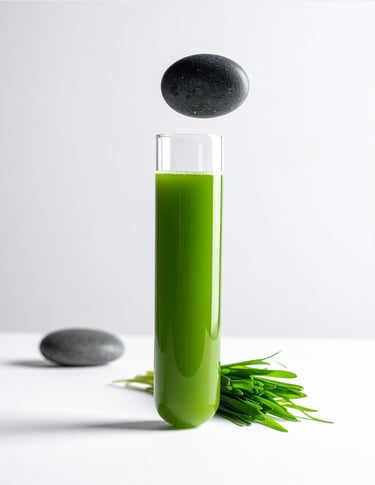
Modulation, Not Stimulation: Why Wheatgrass is Different for Autoimmune Health
The "Overactive" Immune System
In the world of wellness, we are constantly told to "boost our immune system." But for someone living with an autoimmune condition—whether it’s Rheumatoid Arthritis, Lupus, or Hashimotos—the immune system is already too active. It is in a state of "panic," attacking the body's own healthy tissues. In these cases, you don't need a "boost"; you need Immunomodulation—a way to signal the immune system to return to a state of calm, balanced surveillance.
The Mechanism: Signaling the "Off-Switch"
Wheatgrass contains specific bioactive molecules, such as the flavonoid Apigenin and Luteolin, that act as biological messengers. They don't just provide vitamins; they talk to your cells.
Cytokine Down-Regulation: In an autoimmune flare-up, the body produces high levels of pro-inflammatory cytokines (like TNF-α and IL-6). These are the "alarm bells" of the immune system.
The "Brake" Pedal: Research shows that the compounds in wheatgrass can help inhibit the pathways that produce these cytokines. Instead of suppressing the entire immune system (like some pharmaceutical drugs), it helps "down-regulate" the overproduction of the specific proteins causing the inflammation.
The "Buffer" Effect:
The Problem: Metabolic Stress The idea that you can change your blood pH with food is a myth—your body is far too efficient to let that happen. However, modern diets high in processed proteins and refined sugars create a high Potential Renal Acid Load (PRAL). To keep your pH stable, your kidneys must neutralize this acid. If your diet doesn't provide enough minerals to do the job, your body is forced to "borrow" alkaline buffers—like calcium and magnesium—directly from your bones and muscles.
The Solution: Mineral Donation Fresh wheatgrass juice has a highly negative PRAL value. It doesn't "change" your pH; it acts as a mineral donor. By providing a concentrated payload of bioavailable magnesium and potassium, wheatgrass provides the kidneys with the external tools they need to neutralize metabolic waste. This spares your internal mineral stores and reduces the systemic stress that often keeps autoimmune inflammation "simmering."
The Evidence: Systemic Calm
While autoimmune conditions are diverse, the common thread is the inflammatory pathway. Studies on Ulcerative Colitis (an autoimmune-driven gut condition) provide the "Gold Standard" proof: by drinking fresh wheatgrass juice, patients saw a significant drop in their disease activity index. This wasn't because the juice "cured" the genetics of the disease, but because it biologically dampened the overactive inflammatory signals at the source.
The Protocol for Sensitive Systems
For those with autoimmune sensitivities, the "slow and steady" approach is best. Starting with 15ml (half a shot) and moving to 30ml allows the body to integrate the high mineral and enzymatic load without triggering a "cleansing" reaction that might feel like a flare-up.
Scientific References
The Study: Wheat grass juice in the treatment of active distal ulcerative colitis. (Clinical evidence of immunomodulation). Authors: Ben-Arye, E., et al. Published In: Scandinavian Journal of Gastroenterology (2002) Access via: https://doi.org/10.1080/003655202317316088
The Study: Potential renal acid load of foods and its influence on urine pH. Authors: Remer, T., & Manz, F. Published In: Journal of the American Dietetic Association (1995) Access via: https://doi.org/10.1016/S0002-8223(95)00219-7
The Study: Wheatgrass: Green Blood can Help to Fight Cancer. Authors: Rucha Diwakar Gore, et al. Published In: Journal of Clinical and Diagnostic Research (2017) Access via: https://pubmed.ncbi.nlm.nih.gov/28764290/
Contact
hola@elchupitosano.com
+358 400 772 999
El Chupito Sano © 2026. All rights reserved.

Legal Disclaimer: This product is a food supplement (zumo vegetal). Not intended to diagnose or cure disease. If you have a wheat allergy, consult your doctor (though wheatgrass is gluten-free).